Stuttering, or dysphemia, is a speech fluency disorder that causes involuntary interruptions or disfluencies in speech, such as:
- Repetitions of a sound or syllable: “I’d like a c-c-c-c-c-coffee, please.”
- Prolongations of sounds: “We’ll celebrate the birthday in Baaaaaarcelona.”
- Blocking speech: “Tomorrow I’m going to rehearse.”
It’s important to note that everyone stutters differently and that not everyone experiences the same disfluencies.
When a person stutters, they experience a feeling of losing control of their speech, which, in the long run, can lead to emotions and behaviors associated with the stuttering itself. The person may incorporate certain movements or behaviors to try to escape the situation of losing control of their speech or to hide it. We found two types:
- Escape behaviors: facial and/or body movements associated with speech, such as blinking, neck stretching, rocking, etc.
- Avoidance behaviors: not participating in class, substituting one word for another, avoiding speaking, looking away while speaking, etc.
Stuttering typically begins in childhood, when a child starts to say their first words, although it is often mistaken for typical childhood speech difficulties. It affects people of all social classes and races; however, it is four times more common in men than in women.
Origin and factors
Stuttering doesn’t have a single cause; it results from an interaction between genetic, neurological, and environmental factors. That’s why people who stutter often have a family member who also stutters. Thus, the origin is not psychological, and despite popular belief, stuttering is not associated with anxiety, nor is it a consequence of anxiety. However, stuttering can generate anxiety in those who experience it, even developing into social phobia, where there is a fear of stuttering in front of others, often leading to social isolation. Ultimately, the potential psychological effects are a consequence of the experience of stuttering.
The environment is a determining factor, since the main characteristic of stuttering is its variability. That is, stuttering varies from one situation to another. For example, depending on the environment, it won’t be the same at home as in a coffee shop; depending on the person, it won’t be the same with close family members as with their boss; Depending on their emotional state, people tend to stutter more when they are tired, sick, or very excited; or depending on the type of communicative activity, since explaining the weekend to a friend is not the same as conducting a job interview.
Psychological component
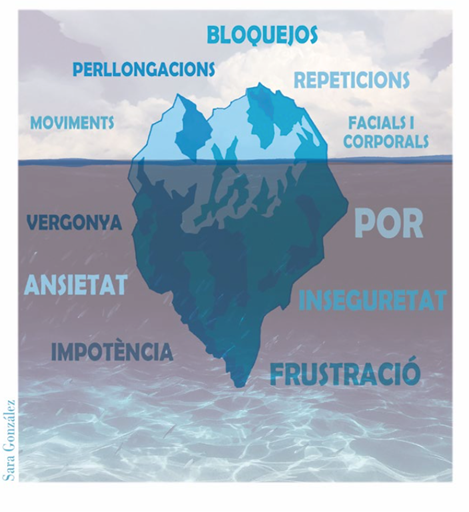
Adaptation and translation of Sheehan’s Iceberg Theory
Stuttering is like an iceberg, where the visible part, what people see and feel, is the smallest portion. The greater part lies beneath, where fear, frustration, helplessness, shame, anxiety, and insecurity can accumulate when communicating. All these feelings and emotions must be acknowledged and addressed to promote the person’s emotional well-being and quality of life.
The psychological effects of stuttering can be severe, continuously affecting a person’s mood. Furthermore, stuttering continues to be highly stigmatized, and the person’s intelligence and emotional skills are constantly questioned, as it is mistakenly believed that simply “calming down” or “focusing more on what they are saying” will lead to fluent speech.
Despite stuttering, anyone who stutters can live a completely happy and fulfilling life, both professionally and socially. This is one of the goals of ATCAT and its self-help groups: not necessarily to reduce stuttering, but to enhance people’s social skills and boost their self-esteem. ATCAT facilitates access to speech therapists specializing in stuttering for adults who stutter and for families seeking speech therapy and support for their child.